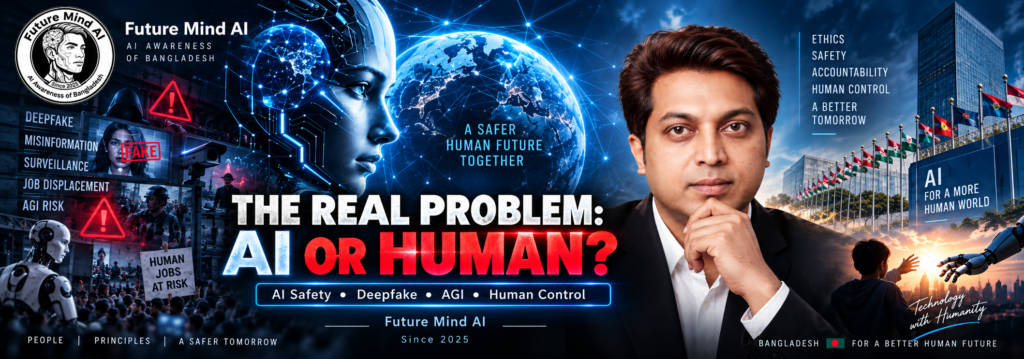
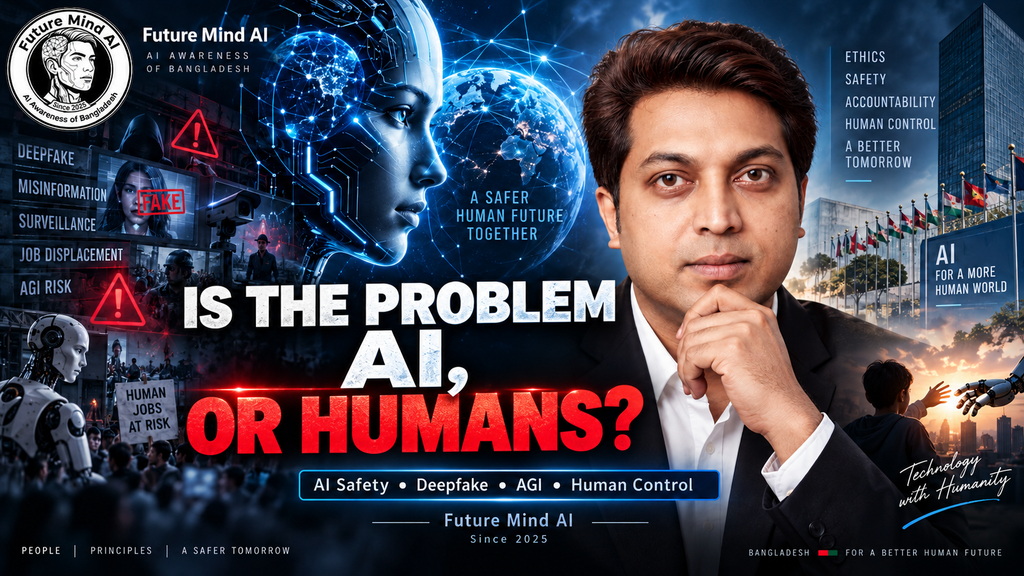
IS THE PROBLEM AI, OR HUMANS?
By Md. Mashiur Rahman
Future Mind AI
Artificial Intelligence is rapidly becoming one of the most powerful technologies humanity has ever developed. But an important question remains:
Is AI itself the problem, or is the real problem how humans develop, control and use it? From the perspective of Future Mind AI, AI itself is neither inherently good nor bad.
Humans created AI.
Humans determine how AI is developed.
Humans decide how it is used.
And human decisions can ultimately make AI either beneficial or dangerous.
Nearly a year ago, I raised a number of questions and concerns about the future of Artificial Intelligence. Today, similar concerns are increasingly being discussed by researchers, technologists, policymakers and international organizations around the world.
This is encouraging-not because the risks are increasing, but because the world is finally beginning to take these questions more seriously.
THE RISKS ARE ALREADY VISIBLE
The global conversation around AI now includes concerns related to:
- Employment and workforce transformation
- Economic disruption
- Deepfakes
- Voice cloning
- Online fraud
- Identity manipulation
- Blackmail
- Misinformation and disinformation
- Harmful synthetic content
- Advanced AI and AGI
- Robotics
- Human control over increasingly powerful intelligent systems
These concerns deserve attention. But simply identifying problems is not enough.
THE WORLD NOW NEEDS SOLUTIONS
The next phase of the global AI discussion must focus on practical solutions.
Future Mind AI believes that countries, international organizations, researchers, technology companies and policymakers should work together to establish effective international safety frameworks for Advanced AI and future AGI systems.
AI development should include:
- Strong safety assessment
- Independent oversight
- Misuse prevention
- Accountability
- Transparency
- Responsible deployment
- Human-centered design
- Meaningful human control
AI SHOULD SUPPORT HUMANITY-NOT DOMINATE IT
The purpose of AI research should be to improve human life.
AI should help people work more efficiently, learn more effectively, receive better healthcare, improve productivity, increase accessibility and solve complex social and scientific problems.
AI research should not move toward systems designed to manipulate, dominate or replace meaningful human decision-making without appropriate safeguards.
As AI systems and robotics become more capable, clear boundaries will become increasingly important. The world must ensure that future AI and robotic systems remain safe, controllable and aligned with human welfare.
CONTENT CREATION ALSO NEEDS RESPONSIBLE RULES
AI-generated content has already created new challenges.
Deepfake videos, cloned voices, fake images, fabricated conversations and synthetic identities can be used for:
- Fraud
- Blackmail
- Character assassination
- Identity theft
- Financial scams
- Political or social misinformation
- Harassment
- Manipulation
- Reputation damage
Every country should therefore develop clear policies for responsible AI-powered content creation and rapid action against harmful misuse.
Today’s misuse may seem limited to digital content.
But if irresponsible users gain access to increasingly powerful AI systems and advanced robotics in the future, the consequences could become far more serious.
This is why misuse prevention must begin now.
DO NOT ONLY IDENTIFY THE PROBLEM-BUILD THE SOLUTION
My appeal to researchers, technologists, international institutions, policymakers and influential leaders around the world is simple:
Do not only identify AI risks and create fear among the public. Build the solutions. Create practical frameworks. Establish international cooperation. Develop enforceable safety standards. Invest in responsible AI education. Strengthen public awareness. Protect human rights, identity and dignity. And most importantly, ensure that meaningful human control remains at the center of AI development.
NO TECHNOLOGY SHOULD STAND ABOVE HUMAN INTEREST
No individual, corporation or technology institution should operate above national law, public safety or the broader interests of humanity.
At the same time, no single country or international organization can solve the challenges of Advanced AI alone. AI is a global technology. Its risks can cross borders. Its benefits can also reach every part of the world. That is why global cooperation is essential.
Bangladesh, like every other country, should also participate actively in building responsible AI policies, awareness, education and governance frameworks.
THE TIME TO ACT IS BEFORE AGI BECOMES WIDELY ACCESSIBLE
The most important decisions may need to be made before Advanced AI and AGI become significantly more powerful and widely available.
Waiting until serious damage occurs would be a mistake. Prevention is more effective than reaction. Safety must develop alongside capability. Governance must develop alongside innovation. And awareness must grow alongside adoption.
THE CENTRAL MESSAGE OF FUTURE MIND AI
AI was created by humans. Therefore, meaningful control over AI must remain in human hands. AI itself is not evil. Humans can use AI to improve lives, increase knowledge and solve problems. But humans can also misuse AI in ways that create harm. That means the future of AI will depend not only on how intelligent our machines become-but also on how responsible humans choose to be.
The decisions made today may shape the safety, freedom and opportunities of future generations. The question is therefore not simply: “Will AI become dangerous?” The deeper question is: “Will humanity develop the wisdom, responsibility and cooperation needed to use AI safely?”
This is the challenge before us.
And this is the conversation Future Mind AI believes the world must have now.
Md. Mashiur Rahman
Future Mind AI
Since 2025
Pioneer of AI Ethical Use & AI Awareness in Bangladesh.